snapSHOT
Project type
Digital Prototype
(Vertical slice)
Role
Sole developer
Association
2nd Year BA

Project date
Early 2026
Team size
1
The Prototype

Documentation
<- Design documentation
(Viewable as a PDF)
Rational Document ->
(Viewable as PDF)
Latest Build
Going up on GitHub shortly.
The prototype has been left in an early stage as personal life matters have meant that I haven't had the time to come back to this project, but the GitHub has what I have.
Project brief
The brief for this project tracks, for the most part, the assessment brief of the "Design Games" module I've taken as part of my 2nd Year BA course.
The requirements imposed by this are very open, to the point that I find it most appropriate to quote from the module.
"The game you choose to develop should be a small prototype, proof-of-concept, or vertical slice of a larger idea. Focus on a few key mechanics that can be successfully designed, implemented, and refined within the teaching block. Subject matter should be appropriate for an age rating of PEGI 18 or lower.
It is therefore NOT expected to be a polished or complete project and may likely include placeholder assets and grey-boxed levels. It should instead simply aim to communicate the kind of the game you could make given more
time/resources."
This comes from the fact that the module focuses more on analysing the process.
Consequently, I get to make a protoype for an idea I've had in my back pocket for a bit as this is one of the rarer opportunities where I can justify a concentrated effort sink into it.
Design discussion
This project is the closest thing I have to an imitation of another game of those in my portfolio. This comes from the fact that the vertical slice I've built is heavily inspired by Ubisoft's Heroes of Might and Magic series and the combat system it uses.
While this inspiration does expand to a lot of (what has become) the 'B-side' of the game, there is also a deliberate choice to try and bring it into a different context through the design to try and make something new from it. It's this distinction that the 'A-side' keeps by switching the genre of the game towards a more story driven, action game.
With the way the idea for the development is structured, this means the game (from the perspective of development) has two strands that are effectively independent as to gameplay that intersect through the narrative.
Which leads on to the narrative that dresses the games core functionality. In the end, I've recycled an idea that I haven't found a good use for before this project. In short, Lieutenant for a European army (alternate timeline) captured as a prisoner of war fighting for their freedom.
In this context the A- and B-sides were derrived from a story perspective. The A-side ('main' gameplay) takes the player into a prison camp not too far from the mainlines of a war in Europe. Playing as the Lieutenant, they must rally and co-ordinate their troops to create the opportunity for rebellion - though that may not be the simplest task due to some lingering memories.
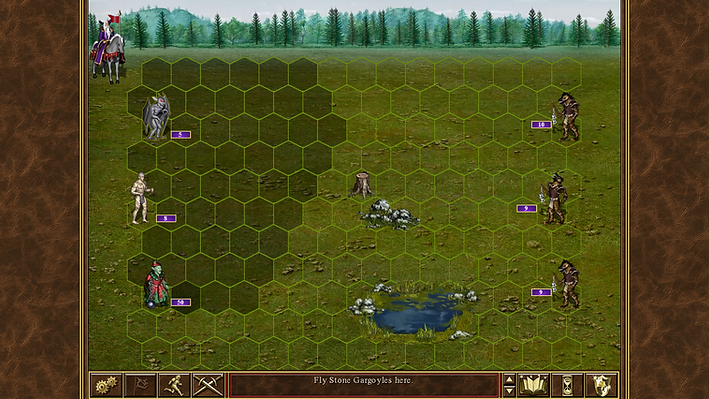
Inspiration
The slides above show some of the gameplay from Heroes of Might and Magic III (HD edition). These cover the core features of the combat encounters, troops, settlements and game board (from a selection of factions in the game).

Encounter designs
Layouts and sketches for the hex grid and example scenarios.
Player troops in blue, enemy troops in orange and obstacles in red.
Troop design is based around a few core stats: HP, defence, speed, initiative, range (including AOE attacks) and damage. Broadly the different troops can also be considered on two axes as to how they play: control to focus damage and swarm to heavy hitting units.
In the early game, onboarding focuses mostly on the use of control and dealing damage with the troop selection mostly leaning towards lower quantities of what may be considered 'swarm' units. As the scenarios progress, the introduction of lower quantity heavy hitting units is initially done through placements on the enemy line up before the player has access to them.
Most attacks in the game are single strike attacks only damaging enemies in one tile. Some units, however, do utilise area of effect attacks to disincentivise clustering of units and provide greater control effects (most notably the grenadiers). These attack types are limited to a select few troops that often have a higher risk expected usage.
Some troops are also exclusively used by the enemy. This decision is made for two key reasons: making scenarios more varied and engaging as well as narrative consistency.
snapSHOT's troops are not designed to feel like a contemporary army but instead draw more from battles before rifles and weapon systems. The grenadiers are a slight deviation from a strict interpretation of this, but also don't utilise grenades in the modern sense - rather throwing crude explosive material.
B-Side gameplay explores these memories at the time in the past that they were made. If developed on a scale beyond a prototype, these would ideally be introduced by cutscenes that set up each encounter before shifting over to the battle part of the game.
Battle takes place across a hex grid which varies in size depending on the scenario. The grid is set up based on preset arrangements in either a 'standard' or 'ambush' form. Play proceeds based on an order of initiative derived from unit stats.
On each turn, a unit may move, attack, move with an attack or defend. Each unit may only take one turn per pass of initiative and it cannot by waved. When being attacked a unit may also make a retaliatory strike.
To encourage the use of different strategies across encounters, the grid terrain and units provided for each side vary between the different scenarios. The main factors that change to provide this variation is the concentration and cover of terrain obstacles as well as the presence and number of ranged units.
There is also one occurrence where the mechanics of B-side gameplay bleed over into the A-side of the gameplay - namely the climax situation.

Troops
Shown above is some of the early stage visual concepts for the troops used in the defined scenarios. (These are designed to be rough sketches for a first pass with an art team, nothing too detailed.)